GEORGE WEAH: FROM FOOTBALL PITCH TO PRESIDENTIAL PALACE?
GEORGE WEAH: FROM FOOTBALL PITCH TO PRESIDENTIAL PALACE?
George Weah, 51, emerged from
Liberia’s slums to become a superstar footballer in the 1990s, and has
leveraged his status as a revered figure among young people in his second run
for the presidency.
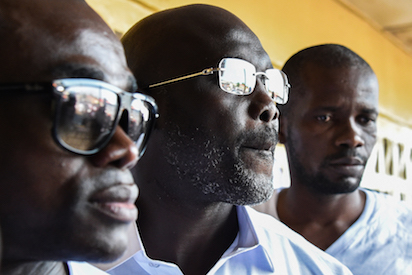

Former international Liberian football star turned
politician, and presidential election candidate George Weah (C) waits prior to
casting his vote for Liberia’s presidential and legislatives elections, at a
polling station in Monrovia on October 10, 2017.Liberians head to the polls on
October 10 to elect a new president in a contest set to complete the country’s
first democratic transition of power in more than 70 years. / AFP PHOTO
Now
Weah has a confirmed place in the runoff round against incumbent Vice-President
Joseph Boakai on November 7, the result of 12 years spent seeking to build
political credibility to match his huge popularity.
The first African player to win both
FIFA’s World Player of the Year trophy and the Ballon d’Or, Weah was largely
absent from Liberia during the 1989-2003 civil war period, playing for a string
of top-flight European teams including PSG and AC Milan. After running
unsuccessfully for the presidency in 2005, when he was defeated by Ellen
Johnson Sirleaf, Weah — whom he now hopes to succeed — says he has “gained
experience” since becoming a senator in 2014.
Another fruitless run for the
vice-presidency on the ticket of presidential candidate Winston Tubman in 2011
brought him to further prominence among the nation’s voters, many of whom say
it is “Weah’s turn” this time. Weah has put education and job creation at the
centre of his platform, in line with most of Liberia’s 19 other presidential
candidates. Surrounded by cheering supporters after casting his vote on Tuesday,
Weah declared his “love for this country will make me a good president”. –
Beloved by young and poor – Younger voters
overwhelmingly favour Weah, who is idolised in his country as “Mister George”.
A member of the Kru ethnic group mired in poverty, Weah was raised by his
grandmother on a reclaimed swamp in one of the worst slums of Monrovia.
“Grassroots citizens identify with George Weah, considering that he is close to
their day-to-day experience,” explains Ibrahim Al-Bakri Nyei, a Liberian
political analyst at London’s School of Oriental and African Studies (SOAS).
One of his most fierce critics,
longtime opposition leader Charles Brumskine, has derisively called Weah “a
rather accomplished football player,” saying he is not prepared to run a
country. “Senator Weah who talks about change is completely out of his league,
we are talking governance here, we aren’t talking to sports,” Brumskine said
during campaigning. But many voters see a poor boy from the slums who made good
against the odds.
“I believe that whenever we give him
a chance, he will be able to give a better Liberia to the youth and the
homeless,” Andrew Janjay Johnson, a shoeshiner in a Monrovia market, told AFP.
– ‘Vague’ platform – Other critics accuse Weah’s Coalition for Democratic Change
(CDC) of having too vague a political platform, and have challenged his long
absences from the senate since being elected in a race he won over Sirleaf’s
son. Weah has also fended off barbs over his vice-presidential pick, Jewel
Howard-Taylor, the ex-wife of jailed former president and warlord Charles
Taylor.
Howard-Taylor is however also a
respected senator in her own right, bringing him important votes in the key
county of Bong, and along with Sirleaf is one of few powerful women in Liberian
public life. Weah is married to Clar Weah, and his son, Timothy, signed a pro
contract with Paris Saint-Germain in July.


